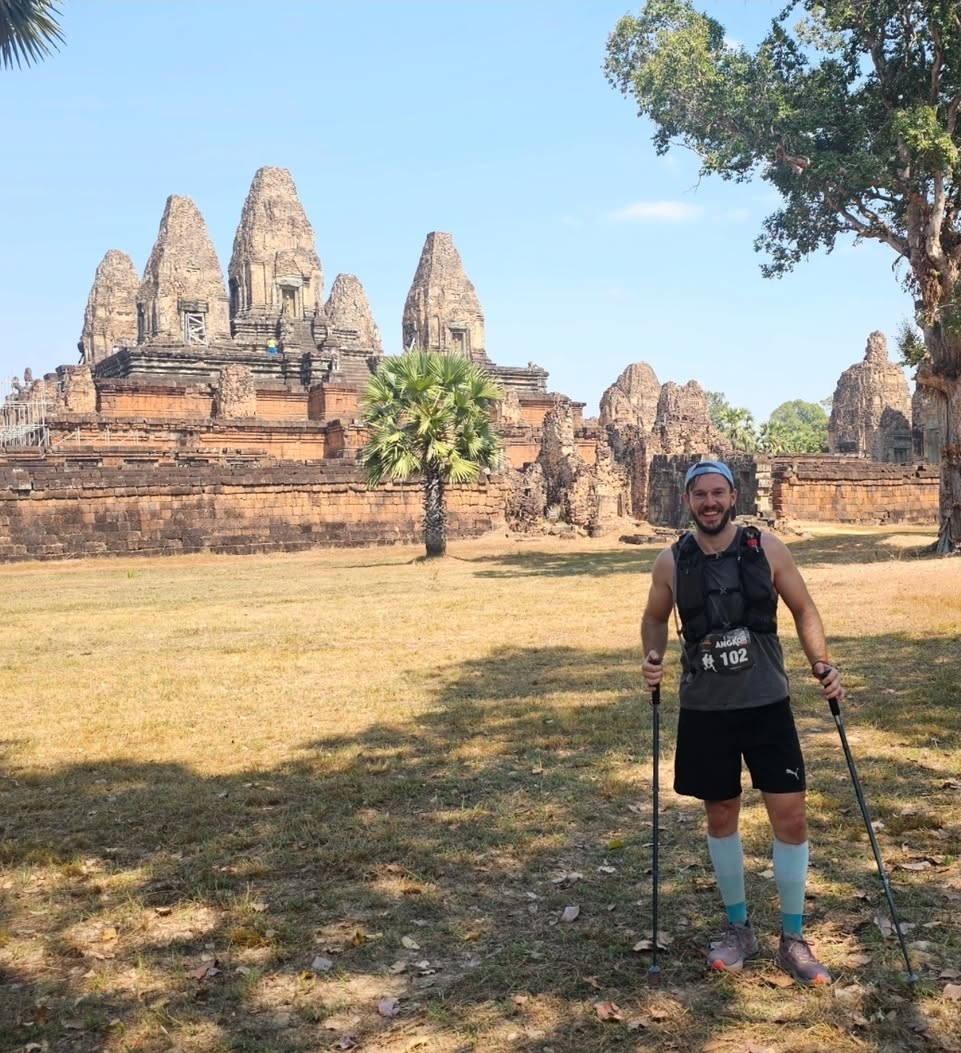
I went into the Ultra Trail Angkor 100km with an ankle injury. Running would likely make it worse, so the plan was clear from the start: I would not race this. I would endure it. I had always assumed "I could walk forever" — that logic gets seriously tested somewhere around kilometre 70.
The strategy was a military march. Almost no breaks, a steady fast walking pace, start at 4am and just keep moving. The maths said it was possible within the 22-hour cutoff without running a single step. I started in the dark and finished in the dark — over 18 hours of walking.
The race is structured as two loops. A 64km first loop, then a 36km second loop. You cross the finish line after the first loop, and then you have to go back out. Going back out was the hardest mental challenge of the entire day. I grabbed a quick hot meal and a coffee and headed out again. That short break is dangerous — it tells your mind "this SHOULD be the end." Convincing your legs to start moving again after sitting down is a battle you fight with yourself.
The second loop was almost entirely in the dark for me. A cheap headtorch that had been perfectly fine for camping turned out to be useless for spotting small trail markings in rice fields and forest. But the unintentional benefit was real: it kept my mind laser-focused on looking directly ahead, no thinking about how far was left, just searching for the next marker, the next kilometre.
Blisters on blisters. I couldn't walk properly for two days afterwards. But I finished without making the ankle worse, which was the whole point. The parallels to professional work are there if you want them — pacing yourself, having a plan and sticking to it, showing up and keeping going when every part of you wants to stop. But I'll keep that light. Sometimes you just want to see if you can do a hard thing. I could.